
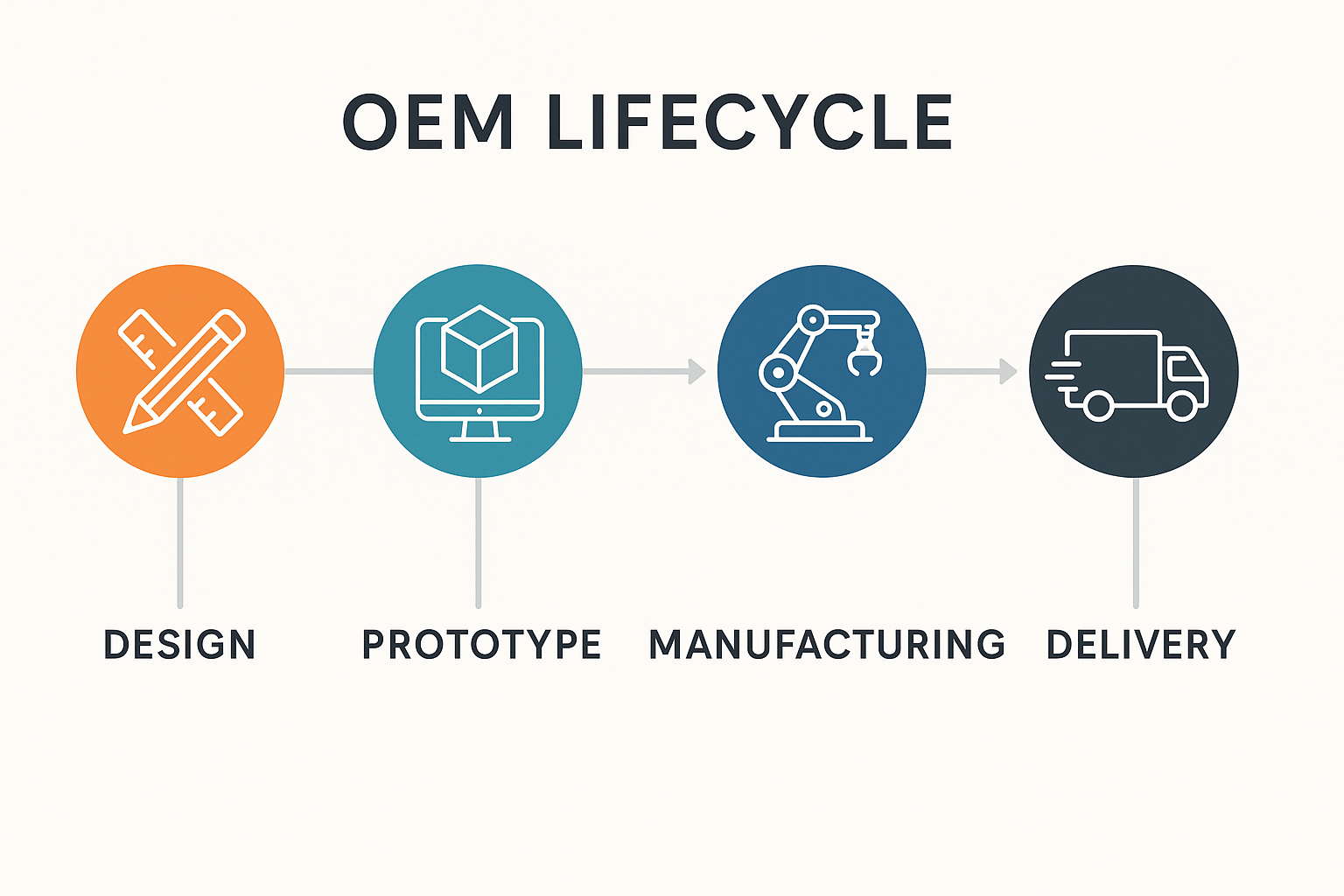
The journey of an electronic device — whether it’s a feature phone, charger, power bank, or TWS — doesn’t begin at a retail store or online listing. It begins long before that, inside an OEM (Original Equipment Manufacturer) facility, where ideas are turned into reality through a strategic and highly coordinated process.
In this blog, we will take you through a step-by-step breakdown of the OEM manufacturing lifecycle, offering insight into how OEMs — like Tryto Mobitech — conceptualize, build, test, and deliver finished products for brands and consumers alike.
🧠 1. Ideation & Product Conceptualization
Everything starts with an idea — whether it’s a market demand, a technological innovation, or a custom request from a brand partner.
During this stage, OEMs:
- Conduct market research
- Study competitors and trends
- Define product functionality and target audience
- Create a product requirement document (PRD)
💡 Example: A brand wants a feature phone with an emergency SOS button for senior citizens. The OEM team works with them to map out the design, specifications, and functionality.
🖊️ 2. Design & Engineering
Once the concept is finalized, the design phase begins. This involves both industrial design (how it looks) and hardware engineering (how it works).
Key activities include:
- 2D/3D CAD renderings
- Component layout and internal schematics
- User interface and control design (if any)
- Material selection and feasibility analysis
Designs must be aesthetic, functional, and production-friendly.
🛠️ OEM Tip: Good design balances innovation with manufacturability — overly complex designs can drive up cost and delay timelines.
🔬 3. Prototyping & Validation
This is where the first physical sample of the product comes to life.
OEMs typically create:
- 3D-printed casing prototypes
- Working electronic circuit boards
- Mockups to test ergonomics and usability
Testing includes:
- Drop tests
- Button responsiveness
- Port placement accuracy
- PCB functioning
Multiple iterations may be required to reach a validated prototype ready for mass production.
🧪 4. Testing & Quality Assurance
Before a product enters mass production, it must pass stringent quality and safety standards.
This includes:
- EMI/EMC testing
- Battery safety checks
- Electrical safety
- Compatibility with chargers, accessories, and networks (for phones)
The QA department also runs:
- Functional tests
- Stress tests
- Aging tests (e.g., continuous operation for 72+ hours)
- Environmental tests (heat, cold, humidity)
✅ OEM Insight: Early testing helps catch costly flaws before mass production begins.
🛠️ 5. Tooling & Molding
Once the product is approved, tooling begins — a critical investment-heavy phase.
It includes:
- Creating molds for plastic injection
- Setting up SMT (Surface Mount Technology) machines
- Preparing jigs and fixtures for assembly lines
Tooling can take 2–6 weeks depending on complexity.
🧰 OEM Note: Molds need to be precise — even a 0.1 mm defect can cause issues in final assembly.
🏭 6. Mass Production & Assembly
This is where the magic happens — the factory floor comes alive with synchronized assembly lines producing hundreds or thousands of units per day.
Steps include:
- PCB assembly (SMT or manual)
- Component soldering
- Casing attachment
- Display and battery integration
- Final product sealing and labeling
Robotics, automation, and human assembly lines all play a role in making the process efficient and error-free.
🧪 7. Final Testing & Inspection
After assembly, each unit undergoes final QC checks to ensure consistent quality.
Tests include:
- Functional button testing
- Display and speaker checks
- Charging and battery verification
- Camera or microphone checks (if applicable)
Any faulty units are reworked or scrapped. OEMs usually operate with <1% defect tolerance.
🔍 OEM Assurance: Every batch is accompanied by QA reports and compliance certificates (e.g., BIS, RoHS, CE).
📦 8. Packaging & Branding
Once cleared for delivery, the product goes through:
- Custom packaging based on client’s brand guidelines
- Accessory inclusion (charger, cables, warranty card)
- Barcode tagging and inventory management
- Brand/logo printing (often via heat press or UV printing)
OEMs often maintain packaging SOPs for different clients and ensure damage-proof packaging during transit.
🚚 9. Logistics & Supply Chain Coordination
Finished goods are now handed over to logistics — a vital phase where timeliness, tracking, and cost efficiency matter most.
OEMs manage:
- Warehousing
- Domestic or international shipping
- Order tracking and batch numbering
- Coordination with freight carriers
📦 Pro Tip: Smart OEMs integrate ERP systems for inventory visibility and just-in-time delivery.
📊 10. After-Sales Support & Feedback Loop
Top-tier OEMs don’t stop at delivery — they offer after-sales support, warranty tracking, and even product performance insights.
This includes:
- Handling replacements or DOAs (dead on arrival units)
- Sharing performance reports
- Logging customer complaints
- Improving future iterations based on feedback
This closes the loop, helping brands deliver better user experiences and OEMs improve product offerings.
🔁 The Lifecycle Is Continuous
Every new product feeds into the next — better learnings, enhanced tooling, new features, faster turnarounds. OEMs constantly refine:
- Design practices
- Supplier quality
- Compliance procedures
- Assembly line workflows
OEMs that own their full lifecycle — from design to delivery — are more agile, consistent, and trusted by their partners.
🧭 Conclusion: Why OEM Lifecycle Mastery Matters
Understanding the OEM manufacturing lifecycle isn’t just about processes — it’s about unlocking efficiency, quality, and innovation.
Whether you’re a startup looking to build your first device or a major brand outsourcing large volumes, working with an OEM that masters every stage of the lifecycle gives you a competitive edge.
From the initial sketch on paper to the final product in a consumer’s hand — OEMs make it happen. Efficiently. Reliably. Repeatedly.
Add a Comment